Can you train your brain from your living room? The question is more common every year, because consumer EEG headsets are easier to buy than ever. This article explains where EEG biofeedback at home comes from, what today’s home neurofeedback devices measure, where their limits are, and when supervised, assessment-led training is the better option.
Key points
- EEG biofeedback, also called neurofeedback, is a form of brain training. A device records brain activity from the scalp and turns it into visual or sound feedback in real time.
- Many home neurofeedback devices exist today, such as Muse, Mendi, Sens.ai, Emotiv headsets and NeurOptimal home systems. Most are designed for well being, meditation or attention practice.
- Devices for home use have technical limits: few EEG channels, dry electrodes, more artefacts and no individual assessment.
- A home EEG device does not diagnose a condition and is not a substitute for medical care.
- At Neurofeedback Luxembourg, training starts with a measurement: a 19-channel qEEG BrainMap. Home training can then be planned around what was measured.
From a laboratory curiosity to a headset in your living room
In 1924, the German psychiatrist Hans Berger recorded the electrical activity of the human brain for the first time. He published his findings in 1929 and named the recording the electroencephalogram, or EEG (Berger, 1929). For decades, EEG stayed in hospitals and laboratories. The machines were large, the electrodes needed conductive gel, and only specialists could read the traces.
In the 1960s, two researchers turned this measurement into a learning tool. Joe Kamiya showed that people could learn to recognise and increase their alpha rhythm when a tone told them it was present (Kamiya, 1968). Barry Sterman, working first with cats and then with people, studied the sensorimotor rhythm and found that it could also be trained through feedback (Sterman and Friar, 1972). Biofeedback became a discipline. It covers heart rate variability, breathing, skin temperature and muscle tension, and EEG biofeedback is its brain-focused branch.
The idea behind all of this is old and simple. A mirror lets you correct your posture because you can see it. A feedback loop lets the brain “see” its own activity, so it can learn to adjust it.
Since the 2000s, smaller electronics have brought EEG out of the laboratory. A clinical system with 19 gel electrodes now sits on one side of the market. On the other side are light headbands that you can order online and pair with a phone. So what can you reasonably expect from neurofeedback at home?
EEG, biofeedback and neurofeedback: the basic terms
- Biofeedback is the real-time measurement of body signals, such as heart rate variability, breathing, skin temperature or muscle activity, with feedback that helps a person learn self regulation (Schwartz and Andrasik, 2017).
- EEG neurofeedback is biofeedback based on brainwave activity. Sensors on the scalp pick up the electrical activity of the brain, and software gives feedback in real time.
- Frequency bands describe brainwave patterns: delta (below 4 Hz, deep sleep), theta (4–8 Hz, drowsiness and light meditation), alpha (8–12 Hz, calm wakefulness), beta (12–30 Hz, active concentration) and gamma (above 30 Hz). These are statistical associations, not a way to read thoughts.
- The learning principle is operant conditioning. When the brain moves towards a target pattern, the software rewards it. With repetition, the brain learns to reach that state more easily. Researchers describe this as a closed loop between the brain and the feedback (Sitaram et al., 2017).
How does a neurofeedback session at home work?
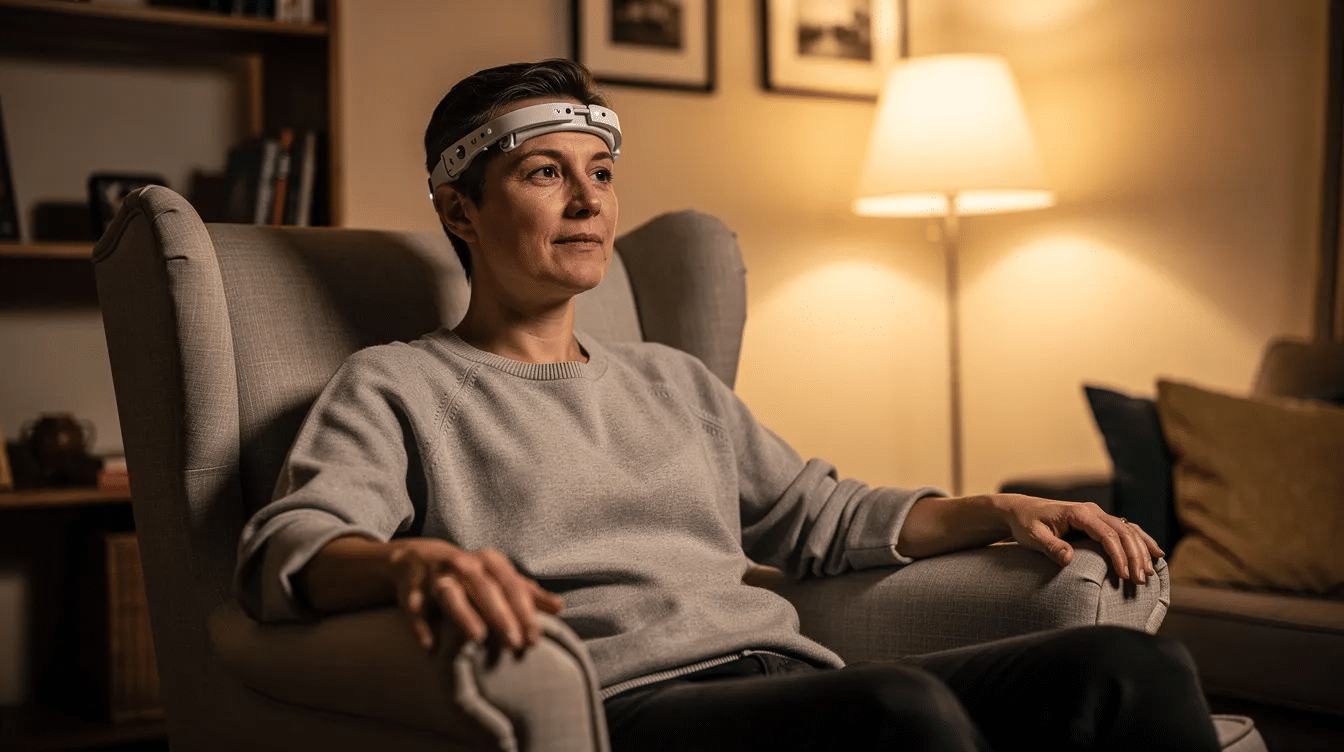
The technical chain is short. An EEG device, either a headband or a headset, records brain activity through sensors on the scalp. The signal goes wirelessly to an app on a phone, tablet or computer. The software filters noise, calculates a few indicators and turns them into feedback.
The feedback loop is the core. When your brain activity moves towards the target set by the software, the program rewards you with a sound, an image or a game that moves forward. When it moves away, the reward fades.
A typical session for home use looks like this. You sit in a quiet room, place the sensors as the instructions describe, and start a session of 20 to 30 minutes. You watch or listen to the feedback change as your attention or calm changes. Over time, many people become more aware of their own mental states. That awareness, practised again and again, is what the training is about.
Repetition matters. Home training plans usually suggest several sessions per week over weeks or months. Like learning an instrument, the brain needs regular practice. With regular sessions, neurofeedback training can improve concentration and can help reduce stress and anxiety. How much any one person gains depends on their goals, the protocol, the device and their consistency, so no result can be promised.
Popular home neurofeedback devices
The market for neurofeedback equipment for home use is large and changes quickly. The examples below are described factually and are not ranked.
- Muse headbands use a few dry EEG sensors on the forehead and behind the ears. They are designed for guided meditation and sleep tracking.
- NeurOptimal is an automated neurofeedback system. It uses a fixed, non-individualised approach, and home systems can be rented or bought through providers.
- Emotiv headsets range from a few channels to 14 or more. They are used by researchers and brain-computer interface developers as well as by private users.
- Mendi is a headband that uses fNIRS, a near-infrared measure of blood oxygen in the forehead, rather than EEG. It offers game-based brain training.
- Sens.ai combines EEG neurofeedback with heart rate variability measures and light-based sessions in one headset.
- Narbis uses glasses that darken or clear depending on the attention level that its sensors measure.
- Myndlift pairs a consumer headset with remote support from a neurofeedback practitioner.
These products are mostly positioned as tools for well being, focus or meditation. Their features, software subscriptions and costs vary widely, and they change often. If you buy one, check the current specifications and price with the manufacturer, and keep your expectations realistic.
What an EEG device for home use can and cannot measure
Electrodes. Most home devices use dry electrodes. They are comfortable and quick to put on, but they make poorer contact with the skin than gel electrodes. The result is a noisier signal, especially at low frequencies (Lopez-Gordo et al., 2014).
EEG channels. One to five channels are enough for simple relaxation or attention feedback at one or two points of the head. A full picture of brain function, including networks, asymmetries and connectivity, needs 19 or more channels placed according to the international 10-20 system.
Artefacts. At home, the signal is often disturbed by blinking, head movement, jaw or forehead tension and electrical interference. Device algorithms remove part of this noise, but not all of it.
Scores. Most home devices show summary scores such as “calm”, “focus” or “stress”. Each manufacturer calculates these with its own algorithm. They are not compared with a normative database and are not a quantitative analysis of your brain state.
Evidence on accuracy. Studies that compared consumer headsets with research and medical systems found that consumer devices do pick up a real EEG signal, for example the classic alpha and event-related responses. They also found lower signal quality and more artefacts than research systems (Krigolson et al., 2017; Ratti et al., 2017). That is useful for practice. It is not the same as an assessment.
Home EEG compared with a clinical qEEG BrainMap
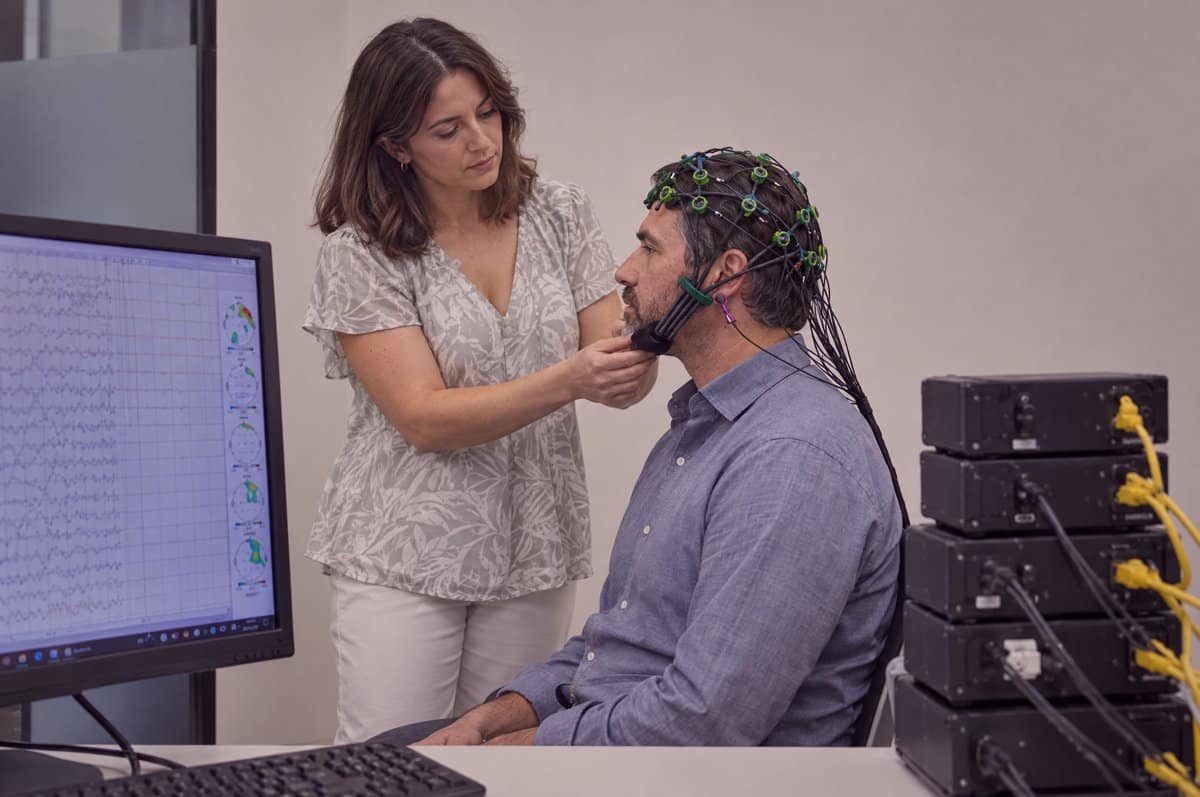
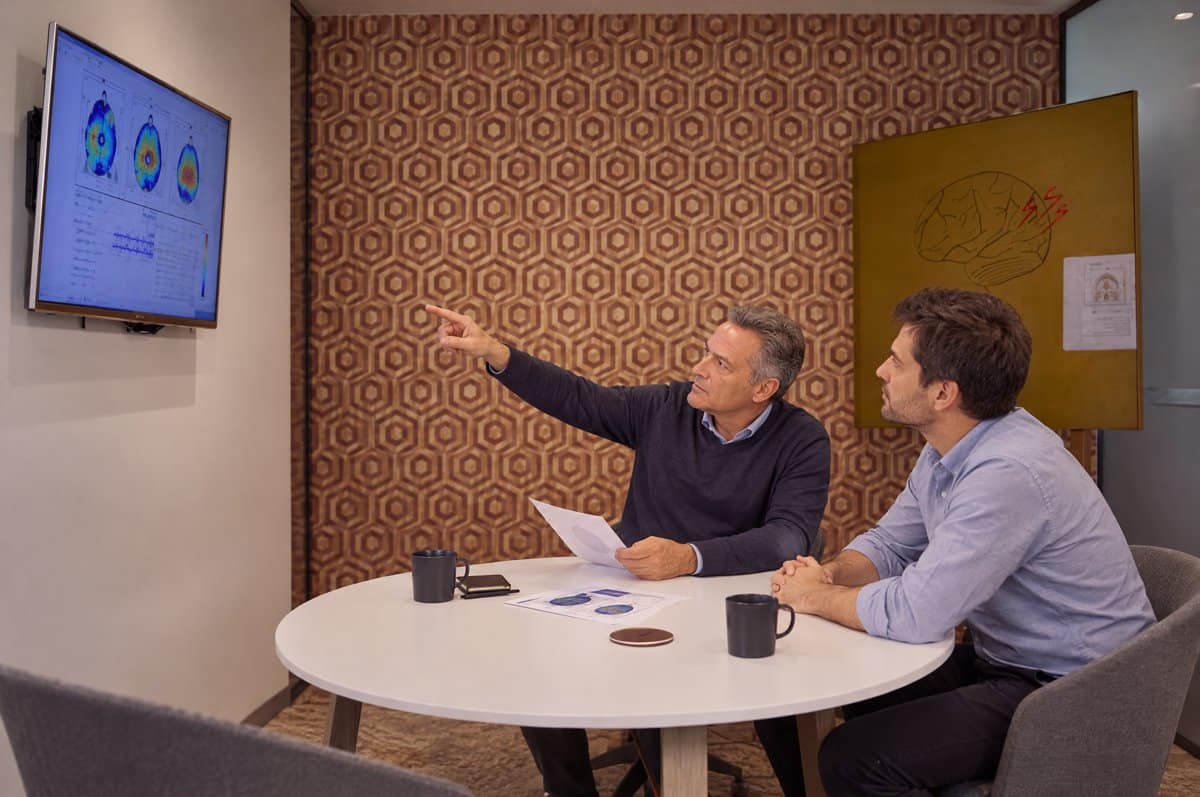
A qEEG BrainMap uses 19 channels with gel electrodes, a standard recording protocol (eyes open, eyes closed, cognitive tasks) and a quantitative analysis compared with normative data. Together with cognitive tests and questionnaires, it gives a detailed picture of brain activity and connectivity. It is a tool for orientation and training planning. It is not a medical diagnosis.
Home systems, by contrast, usually have one to eight channels, proprietary algorithms and settings that are the same for every user. EEG at home can support practice and self-awareness. It does not replace a clinical EEG, an individual qEEG assessment or medical advice.
Why supervised, qEEG-guided training is different

A trained neurofeedback practitioner adds what a device alone cannot. They help you clarify your goals, for example attention, calm, a steadier daily rhythm or performance. They choose the electrode positions and feedback settings, and they adjust the protocol based on how you respond from session to session.
At Neurofeedback Luxembourg, we plan neurofeedback training from a measurement. Protocols can combine classical amplitude training with LORETA Z-score training, which works with networks rather than single points.
What does the research say? Reviews describe a growing body of neurofeedback studies and also important open questions (Marzbani et al., 2016). Results differ between studies, protocols and outcome measures. For example, a meta-analysis on attention difficulties found clearer effects when parents rated outcomes than in blinded assessments (Cortese et al., 2016). Many people who train regularly tell us that it can reduce stress and anxiety and improve concentration. This is why we separate what a study reports from what one person may experience, and why we do not promise individual results.
An illustrative path: clinic sessions and home training together
The following example is a composite. It shows a typical path and does not describe a single client.
A teenager in Luxembourg finds it hard to stay focused in class. After a free telephone call, the family books a BrainMap with 19 channels, cognitive tests and questionnaires. We discuss the findings with the parents and the teenager in plain language, and agree on realistic training goals.
The first phase takes place in the practice, so the protocol can be adjusted closely. Later, the family asks about continuing at home with a consumer headset. Short video check-ins every two weeks let us review how sessions are going, adjust their length and keep motivation up. The BrainMap stays the reference point for these decisions. At the end of the programme, a second evaluation shows what has changed and what has not.
Practical advice for EEG biofeedback at home
- Know your goal before you buy a product. Is it meditation support, attention practice or curiosity about your brain? Different devices suit different goals.
- Check how your brain data is handled. Ask where it is stored, whether you can export it, and who it is shared with.
- Start gently. Keep sessions to 20 to 30 minutes, notice how your body feels, and stop if you feel unusual tiredness, headache or irritability.
- Do not use a home device to answer a medical question. If you are worried about attention, mood, anxiety, sleep or any other health concern, speak to a doctor first.
Where home neurofeedback is heading
Sensors are improving quickly. Dry electrodes are getting better contact, filtering algorithms are getting smarter, and devices increasingly combine EEG with heart rate variability, fNIRS and sleep data. Machine learning may one day adapt home training to each person’s long-term data, so the feedback becomes more relevant over time.
The mirror that Hans Berger first held up to the brain a century ago is becoming smaller, cheaper and more personal. What will matter most is knowing how to read it. Careful measurement, controlled research and good guidance will help people use these tools with clear expectations. The most interesting chapter of home neurofeedback may be the one where consumer devices and clinical assessment work together instead of competing.
If you want to discuss your situation, the simplest first step is a free telephone call. From there, a BrainMap can show where you stand, and a training programme can be planned around it.
FAQ about EEG biofeedback at home
Is it possible to do neurofeedback at home?
Yes. Many consumer EEG devices offer neurofeedback-style training at home. They are useful for practising attention or relaxation. They do not offer the channel count, signal quality or individual assessment of a clinical setting.
Do home neurofeedback devices work?
Consumer headsets do measure a real EEG signal, but with more noise than research systems (Krigolson et al., 2017). Whether training with them helps a particular person depends on their goals, the device and how consistently they practise. Independent research on specific consumer products is still limited.
How many EEG channels do I need for home training?
One to five channels are enough for simple meditation or attention feedback. A detailed assessment of brain networks needs 19 or more channels. More channels do not automatically mean better training; it depends on your goal and how the software uses the data.
Can a child use a home neurofeedback device?
Some headsets fit children. Decide together with a responsible adult, and ideally with a neurofeedback practitioner. Think about comfort, screen time and whether the child can sit still for a session.
Can a home EEG device diagnose a medical condition?
No. Home devices are not designed or validated for diagnosis. If you have a health concern, speak to a doctor.
How can Neurofeedback Luxembourg help if I already own a home headset?
We can start with a free orientation call, then offer a BrainMap to understand your brain activity in more detail. We do not configure or certify consumer devices, but we can explain what your device measures, what it does not, and how home practice could fit into a structured plan.
References
- Berger, H. (1929). Über das Elektrenkephalogramm des Menschen. Archiv für Psychiatrie und Nervenkrankheiten, 87, 527–570.
- Cortese, S., et al. (2016). Neurofeedback for attention-deficit/hyperactivity disorder: meta-analysis of clinical and neuropsychological outcomes from randomized controlled trials. Journal of the American Academy of Child and Adolescent Psychiatry, 55(6), 444–455.
- Kamiya, J. (1968). Conscious control of brain waves. Psychology Today, 1, 56–60.
- Krigolson, O. E., et al. (2017). Choosing MUSE: validation of a low-cost, portable EEG system for ERP research. Frontiers in Neuroscience, 11, 109.
- Lopez-Gordo, M. A., Sanchez-Morillo, D., and Pelayo Valle, F. (2014). Dry EEG electrodes. Sensors, 14(7), 12847–12870.
- Marzbani, H., Marateb, H. R., and Mansourian, M. (2016). Neurofeedback: a comprehensive review on system design, methodology and clinical applications. Basic and Clinical Neuroscience, 7(2), 143–158.
- Ratti, E., et al. (2017). Comparison of medical and consumer wireless EEG systems for use in clinical trials. Frontiers in Human Neuroscience, 11, 398.
- Schwartz, M. S., and Andrasik, F. (Eds.) (2017). Biofeedback: a practitioner’s guide (4th ed.). Guilford Press.
- Sitaram, R., et al. (2017). Closed-loop brain training: the science of neurofeedback. Nature Reviews Neuroscience, 18(2), 86–100.
- Sterman, M. B., and Friar, L. (1972). Suppression of seizures in an epileptic following sensorimotor EEG feedback training. Electroencephalography and Clinical Neurophysiology, 33(1), 89–95.
Neurofeedback is brain training and is not a substitute for medical advice.