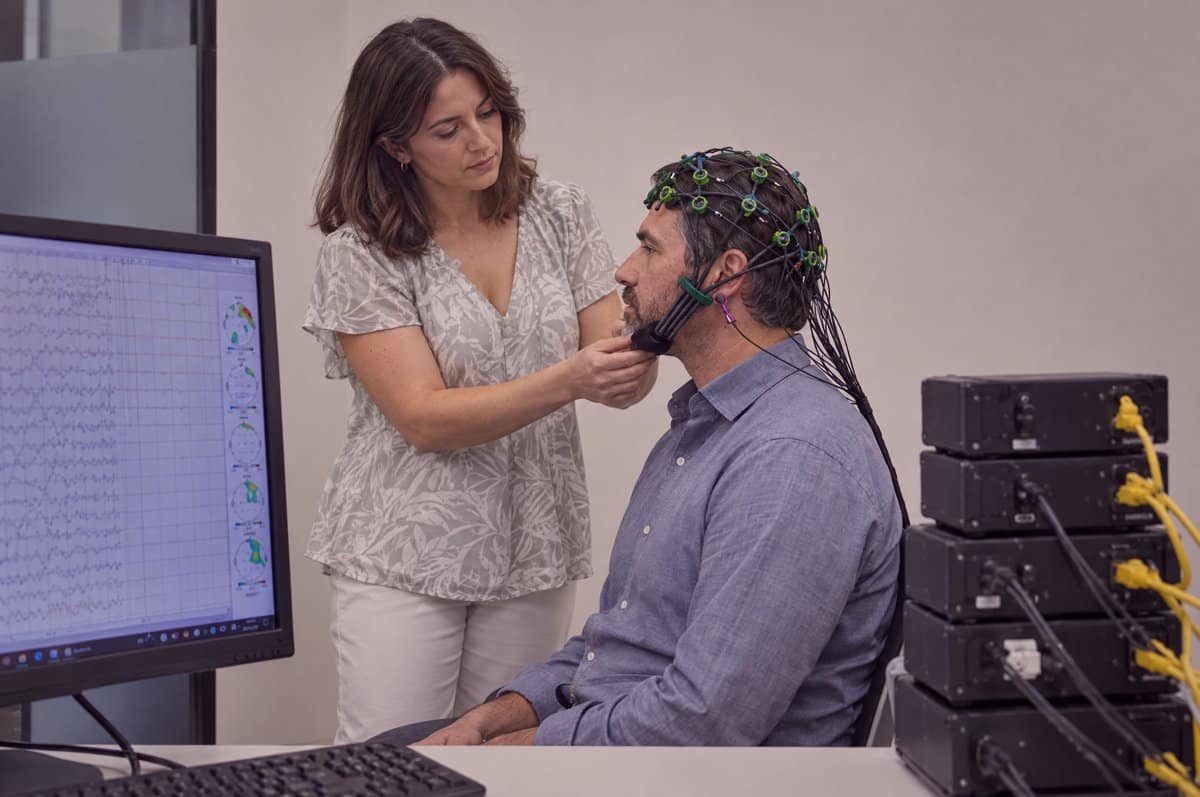

In 1976, Joel Lubar and Margaret Shouse published a short report about one hyperactive boy. They had trained him to produce more of a brain rhythm called the sensorimotor rhythm, watched his behaviour change, and written it down. That single case started fifty years of research on neurofeedback for ADHD. Today it is the most studied non-drug approach to ADHD there is, and also one of the most argued about.
In 2022 an editorial in the American Journal of Psychiatry asked the question in its title: “Neurofeedback for ADHD: Time to Call It Quits?” In 2025 a large meta-analysis seemed to answer yes. This spring a new review by Andrew Hill, PhD, asks a narrower question that matters for families and for practices like ours: what exactly did the trials test?
What the strongest trials found
Research finding (meta-analysis of 38 randomised trials, 2,472 participants aged 5–40; Westwood et al., European ADHD Guidelines Group, JAMA Psychiatry, 2025). When the people rating ADHD symptoms probably did not know who had received neurofeedback, there was no significant difference between neurofeedback and control conditions: standardised mean difference 0.04 (95% CI −0.10 to 0.18). In the 9 trials that used established standard protocols (681 participants), there was a small but significant effect: 0.21 (95% CI 0.02 to 0.40).
Research finding (double-blind, sham-controlled randomised trial, 144 children aged 7–10; Arnold et al., Journal of the American Academy of Child and Adolescent Psychiatry, 2021). Both groups improved a lot, and neurofeedback did no better than sham at the end of training (between-group d = 0.01). At 13 months the gap had widened to d = 0.23, which was not statistically significant, and the neurofeedback group needed significantly less medication (p = .012).

Read plainly: at group level, the best-controlled trials do not show that neurofeedback beats a convincing sham on parent and teacher symptom ratings. Hill accepts this. His argument is about what that result covers.
The review: five design problems
Hill’s paper, “Five Structural Biases in Neurofeedback-for-ADHD Research: Why the Evidence Looks Weaker Than It Should” (2026), is a narrative review, not a new trial or meta-analysis. He searched the literature up to March 2026 and identifies five features shared by the sham-controlled ADHD trials. Each one, he argues, makes a real specific effect harder to detect.

1. One protocol for everyone
Every sham-controlled ADHD trial gave all participants the same protocol, usually theta/beta training. But EEG and MRI studies keep finding that ADHD covers several biologically different profiles. A protocol built for one profile, given to everyone, can only help the people who have that profile. Research finding (illustrative model in Hill’s review, not a measured result): if 40% of a sample matches the targeted profile and the effect in those people is large (d = 0.8), the whole group shows only d = 0.32. That is below what any of these trials was large enough to detect.
2. A biomarker that stopped working
The theta/beta ratio was once a promising EEG marker of ADHD, and many trials selected children and designed training around it. Later studies found that it no longer separates people with ADHD from people without. One explanation Hill discusses is that children sleep less than they used to, and sleep loss raises theta. A trial that enrols on this marker may enrol a more mixed group than it intends.
3. Fewer sessions than in practice
Many randomised trials used 20 to 30 sessions; the largest used 38. Hill cites clinical case series using 40 to 60. A 2019 meta-analysis found that studies with more training hours tended to show larger effects, and learning curves in one trial were still rising when training stopped. Hill is careful here: no trial has yet varied the number of sessions on purpose, so whether more sessions help is still open.
4. The sham is not a sugar pill
A sham session still means 30 to 45 minutes of focused attention on a screen, rewards, regular appointments, a relationship with a clinician and strong expectations. All of these can help on their own. When both groups improve a lot, a small extra effect needs very large trials to show up. Hill estimates at least 250 participants per group; the largest trial had 144 in total.
5. Questionnaires as the only measure
Almost every trial judged success by parent or teacher questionnaires. These scores also move with sleep, stress, expectations, life events and medication changes. Hill proposes adding a pre-registered EEG measure as a second main outcome, so trials can check whether the brain actually learned and whether that learning tracks with change in daily life.
Is the brain learning at all?
Research finding (double-blind, sham-controlled studies in people without ADHD: He et al., Journal of Neuroscience, 2020; Guler et al., Journal of Neuroimaging, 2021). When feedback was real, the brain produced specific responses that did not appear with sham feedback, and in one study these responses were linked to faster movement. Hill adds his own double-blind EEG study of 40 participants, which found the same pattern. He notes that it is his own preprint and should be weighed accordingly.
Hill draws a clear line here. Evidence that the brain responds to real feedback is necessary for a clinical effect, but it does not prove one.
What the review does not claim
This part matters as much as the rest. Hill writes that his arguments “do not establish that individualized neurofeedback is effective for ADHD.” He also writes that tailoring training to a person’s brain map has not been shown to work better than standard protocols in sham-controlled ADHD trials, and that current evidence does not justify presenting neurofeedback as an established ADHD treatment. He takes the sceptics’ strongest objection seriously too: acupuncture and homeopathy had similar explanations for their null trials, and better trials did not rescue them.
He also discloses a conflict of interest. He works at Peak Brain Institute in Los Angeles, which offers neurofeedback with protocols guided by qEEG brain maps. We have a similar interest: Neurofeedback Luxembourg offers neurofeedback, and every programme starts with a 19-electrode brain map. Please read both of us with that in mind.
What this means if you are considering neurofeedback
- The best-controlled trials do not show that neurofeedback beats sham on ADHD symptom ratings at group level. This review does not change that result.
- What the review questions is how far that result reaches. The trials tested one protocol for everyone, over a short course, against a sham that itself helps. Personalised training over a longer course has not yet been tested in a trial of that kind.
- Measuring before and after training is useful whichever reading turns out to be right. It shows what changed in the brain and what did not, instead of relying on impressions alone.
We collect the main studies on neurofeedback and ADHD, including the null and negative results, on our statistics page: data.neurofeedback-luxembourg.com.
The trial that has not been run
Hill ends with a design rather than a verdict: about 250 participants per group, at least 40 sessions, protocols chosen from each person’s brain map, a convincing sham, and EEG measures alongside questionnaires. A trial like that could come out either way. If it is positive, a fifty-year debate moves on. If it is negative, practices like ours will have to change what we say. Fifty years after that first boy, the question is no longer only whether neurofeedback works for ADHD. It is whether anyone will run the trial that tests it the way it is actually practised.
Sources
- Hill, A. (2026). Five Structural Biases in Neurofeedback-for-ADHD Research: Why the Evidence Looks Weaker Than It Should. Narrative review, Peak Brain Institute. Author’s research page
- Westwood, S. J., et al., European ADHD Guidelines Group (2025). Neurofeedback for attention-deficit/hyperactivity disorder: a systematic review and meta-analysis. JAMA Psychiatry. Free full text
- Arnold, L. E., et al., Neurofeedback Collaborative Group (2021). Double-blind placebo-controlled randomized clinical trial of neurofeedback for ADHD with 13-month follow-up. Journal of the American Academy of Child and Adolescent Psychiatry, 60(7), 841–855. Free full text
- McGough, J. J. (2022). Neurofeedback for ADHD: Time to call it quits? American Journal of Psychiatry, 179(12), 888–889. Article
- Bussalb, A., et al. (2019). Clinical and experimental factors influencing the efficacy of neurofeedback in ADHD: a meta-analysis. Frontiers in Psychiatry, 10, 35. Article
- He, S., et al. (2020). Neurofeedback-linked suppression of cortical beta bursts speeds up movement initiation in healthy motor control: a double-blind sham-controlled study. Journal of Neuroscience, 40(20), 4021–4032. Article
- Guler, S., et al. (2021). Matched neurofeedback during fMRI differentially activates reward-related circuits in active and sham groups. Journal of Neuroimaging, 31(5), 933–941. Article
- Lubar, J. F., & Shouse, M. N. (1976). EEG and behavioral changes in a hyperkinetic child concurrent with training of the sensorimotor rhythm (SMR). Biofeedback and Self-Regulation, 1, 293–306.
Neurofeedback is brain training, not a medical treatment, and does not replace medical advice.