
In short. We avoid boredom so hard that some of us would rather give ourselves a small electric shock than spend fifteen minutes alone with our thoughts. Yet the brain does not switch off when we “do nothing”: a set of regions, the default mode network, gets to work. This guide sorts out what the research actually shows, what viral videos exaggerate, and what a resting-state EEG recording can and cannot reveal.
Our starting point: Jay Shetty’s episode “You Need To Be Bored. Here’s Why.” (Jay Shetty Podcast, YouTube). We checked each of his claims against the original studies. Some hold up, some don’t. We tell you which.
Pascal’s room: why we run from boredom
The line is famous, but rarely quoted correctly. Pascal did not write that “all of humanity’s problems” come from our inability to sit alone. In the “Divertissement” (Diversion) bundle of the Pensées, he wrote: « tout le malheur des hommes vient d’une seule chose, qui est de ne savoir pas demeurer en repos dans une chambre », “all the unhappiness of men comes from a single thing: not knowing how to stay quietly at rest in a room” (fragment Lafuma 136 / Brunschvicg 139, our translation). The word “alone” is not there, and the subject is unhappiness, not problems. As for the date 1654 that circulates everywhere: that is the year of his “Night of Fire”. The fragments were written around 1656–1662 and published after his death, in 1670 (electronic edition of the Pensées).
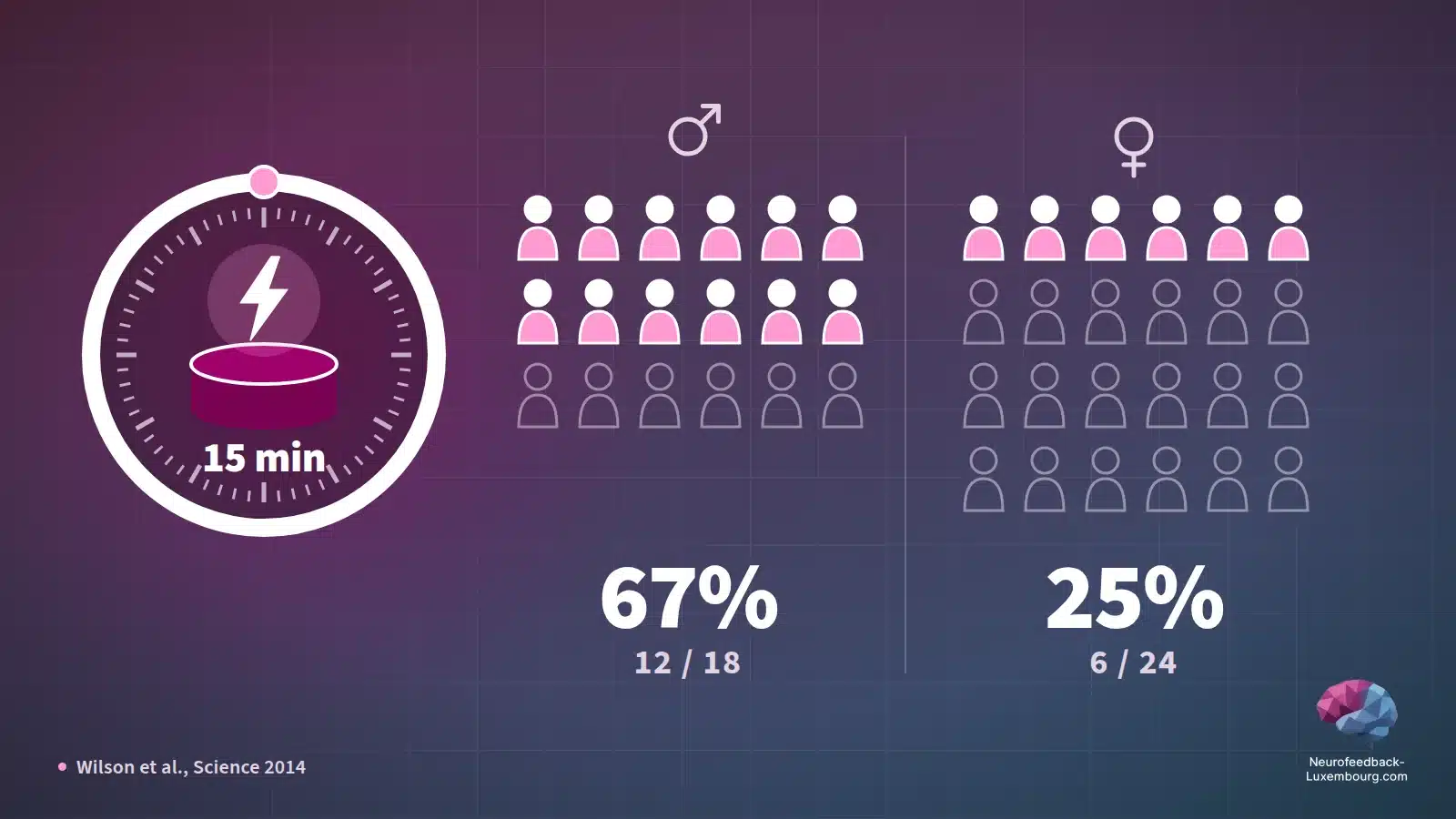
Three and a half centuries later, a team at the University of Virginia put Pascal to the test. In a series of eleven studies, Timothy Wilson and colleagues asked students to stay alone in a room, with no phone and no book, for 6 to 15 minutes. In one of them, participants could give themselves a mild electric shock that they had earlier rated unpleasant enough to pay money to avoid. The result: 12 of 18 men (67%) and 6 of 24 women (25%) pressed the button at least once. One man, excluded from the averages, shocked himself 190 times (Wilson et al., 2014, Science).
That finding is solid. A replication run in 11 countries with 2,557 people found the same phenomenon, with a smaller effect. It adds a detail that concerns all of us: the heaviest phone users enjoyed thinking the least (Buttrick et al., 2019, Journal of Personality and Social Psychology).
What the brain does when it is “doing nothing”
For a long time, brain imaging focused on the brain at work: solving a sum, recognising a face. In 1997, a team at Washington University in St. Louis that included Marcus Raichle noticed a set of regions doing the opposite: they became less active as soon as a task began (Shulman et al., 1997). In 2001, Raichle gave this a name: the brain’s default mode (Raichle et al., 2001, PNAS). Today we call it the default mode network, or DMN.
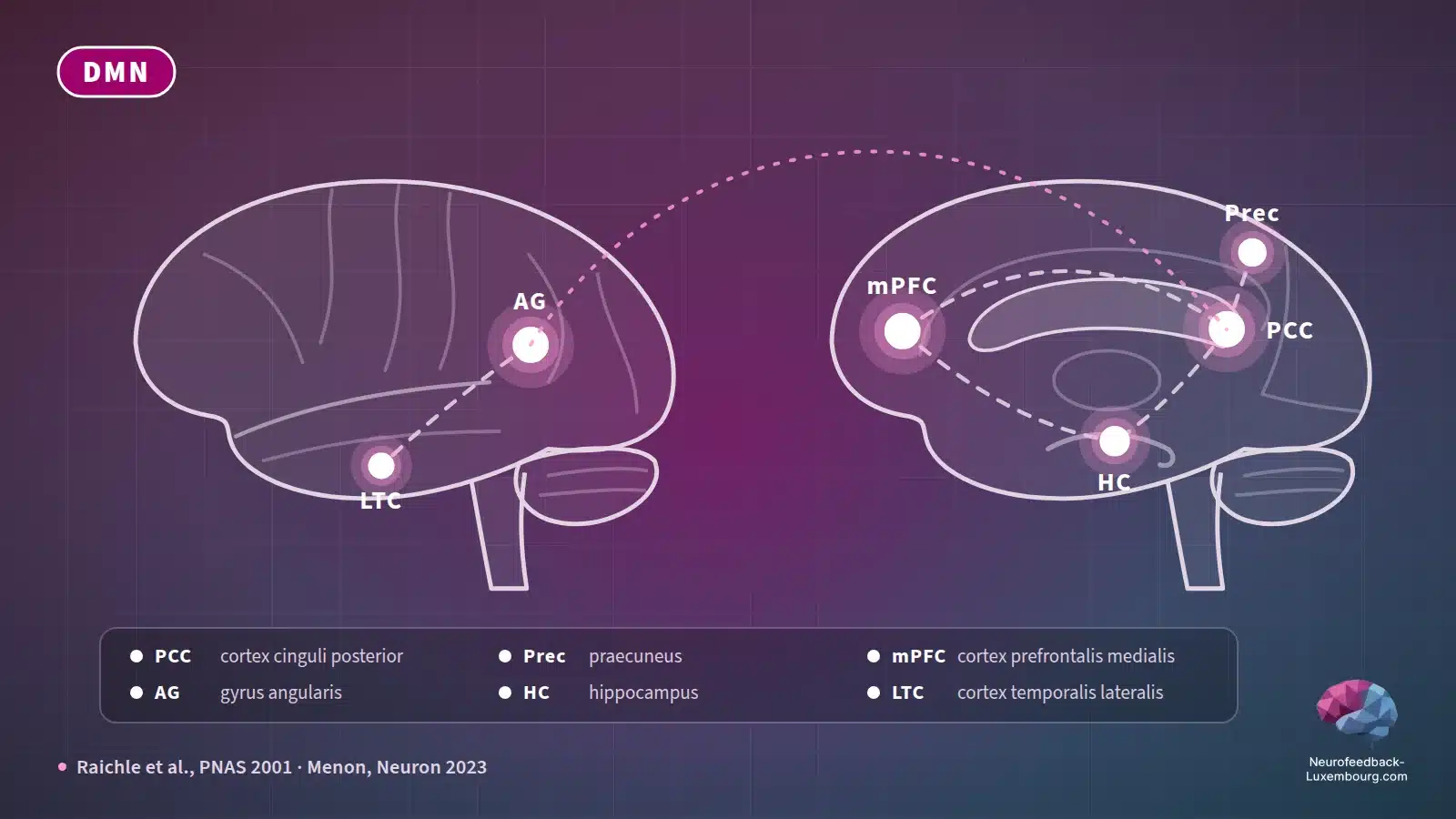
The network links the posterior cingulate cortex, the precuneus, the medial prefrontal cortex and parts of the parietal lobe, among others. Twenty years of research tie it to very human abilities (Buckner et al., 2008; Menon, 2023, Neuron):
- remembering your own story and telling yourself who you are;
- imagining what someone else thinks or feels;
- projecting yourself into the future, rehearsing a difficult conversation before it happens;
- letting your mind wander.
And creativity? The link is real, but subtler than people say. In 163 people, the connectivity pattern linked to the most original ideas connected the default mode network with two other networks, the salience network and the executive control network (Beaty et al., 2018, PNAS). The idea that pops up in the shower comes from cooperation, not from one network working on its own.
No, the default mode network does not shut down when you listen to a podcast
This is the most shared claim in the video, and it is wrong. Jay Shetty says the default mode network “can’t activate” while we consume content, podcasts included. In fact, when we listen to a coherent story, this network is fully engaged: it is what links sentences together and makes sense of them over time (Lerner et al., 2011). Better still, how strongly it coordinated during listening predicted what listeners remembered afterwards (Simony et al., 2016, Nature Communications). Princeton researchers describe it as a “sense-making” network that folds what we take in into what we already know (Yeshurun, Nguyen and Hasson, 2021).
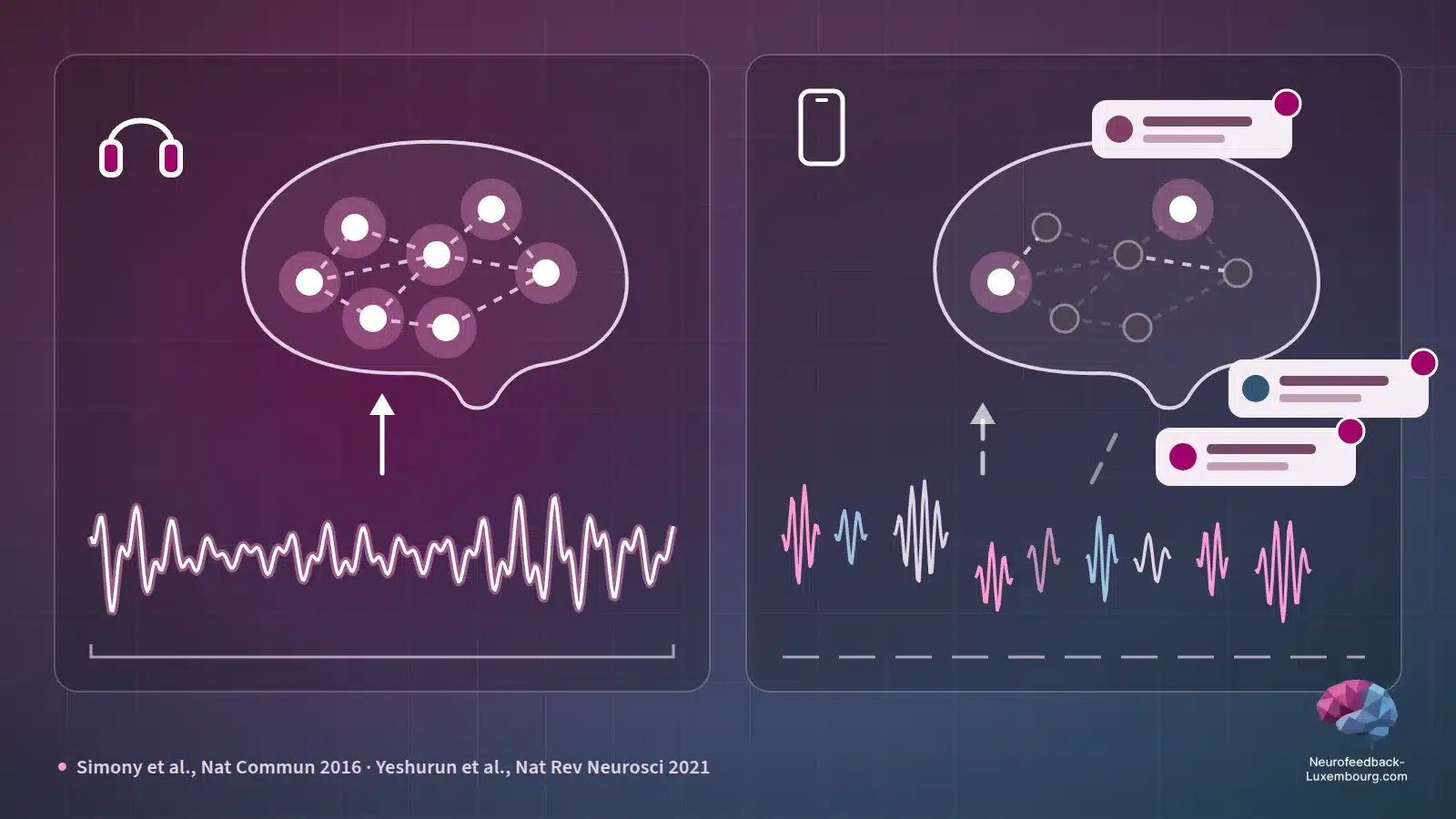
What is true is that the network steps back during demanding, outward-facing tasks. That nuance changes everything. The problem is not listening to something; it is the nature of what we listen to. A long story feeds this network. A feed of fifteen-second videos that keep changing topic leaves it neither the time to connect nor the room for our own thoughts.
Does boredom make you more creative? What the studies really say
It is a lovely story. In 2014, psychologist Sandi Mann (University of Central Lancashire) had volunteers copy numbers out of a phone book for 15 minutes (not 20, as you often read), then asked them to come up with uses for two polystyrene cups. The “bored” group produced more ideas: 10.6 versus 7.3 on average, across 80 participants (Mann and Cadman, 2014, Creativity Research Journal).
But look closer. The ideas were more numerous, not rated as more creative. Reading the numbers instead of copying them made no significant difference on the cup test. Participants who had not been bored were excluded. And the authors themselves called for a larger replication.
It happened. In 2023, a Canadian team re-ran the experiment with 197 people: boredom was linked to slightly worse performance (Nettinga, Gutglick and Danckert, 2023, Journal of Boredom Studies). Another study had already shown that once the practice effect was controlled for, boredom reduced the flow of ideas (Haager et al., 2018). A review of 27 studies concludes that no clear causal effect, positive or negative, is established today (Zeißig et al., 2024).
Our reading: “boredom makes you creative” is not demonstrated. What is solid is that we avoid being alone with our thoughts, and that an undemanding break can sometimes help you come back to a problem with fresh eyes (Baird et al., 2012), even though that result has been debated since too (Murray et al., 2024).
Fruitful daydreaming or rumination?
Letting your mind wander is not always pleasant. In a well-known smartphone study of 2,250 adults, minds were wandering in 46.9% of sampled moments, and people reported being less happy at those moments (Killingsworth and Gilbert, 2010, Science). It all depends on what those thoughts are about: a curious daydream about plans has nothing in common with self-critical loops that keep coming back (Smallwood and Schooler, 2015).
Another interesting idea: boredom may be less a flaw than a signal. It shows up when our attention fails to catch on, or when what we are doing lacks meaning for us (Westgate and Wilson, 2018). Among students, a tendency to get bored easily was linked to problematic smartphone use (Elhai et al., 2018). The phone silences the signal without answering the question it asks.
If, when everything goes quiet, it is mostly dark thoughts that return, in loops, for weeks, that is no longer boredom: talk to your doctor. Our guide to mood regulation and our page on burn-out in Luxembourg can help you see more clearly.
What rest looks like on an EEG
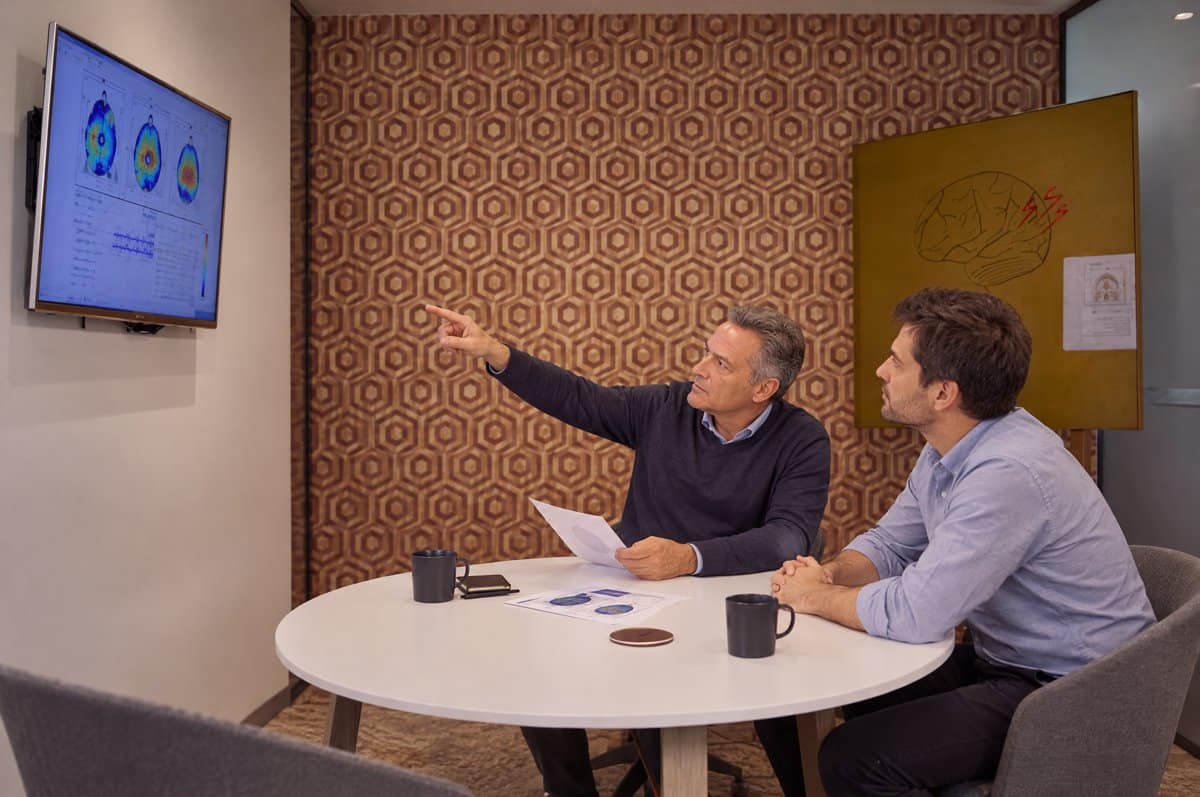
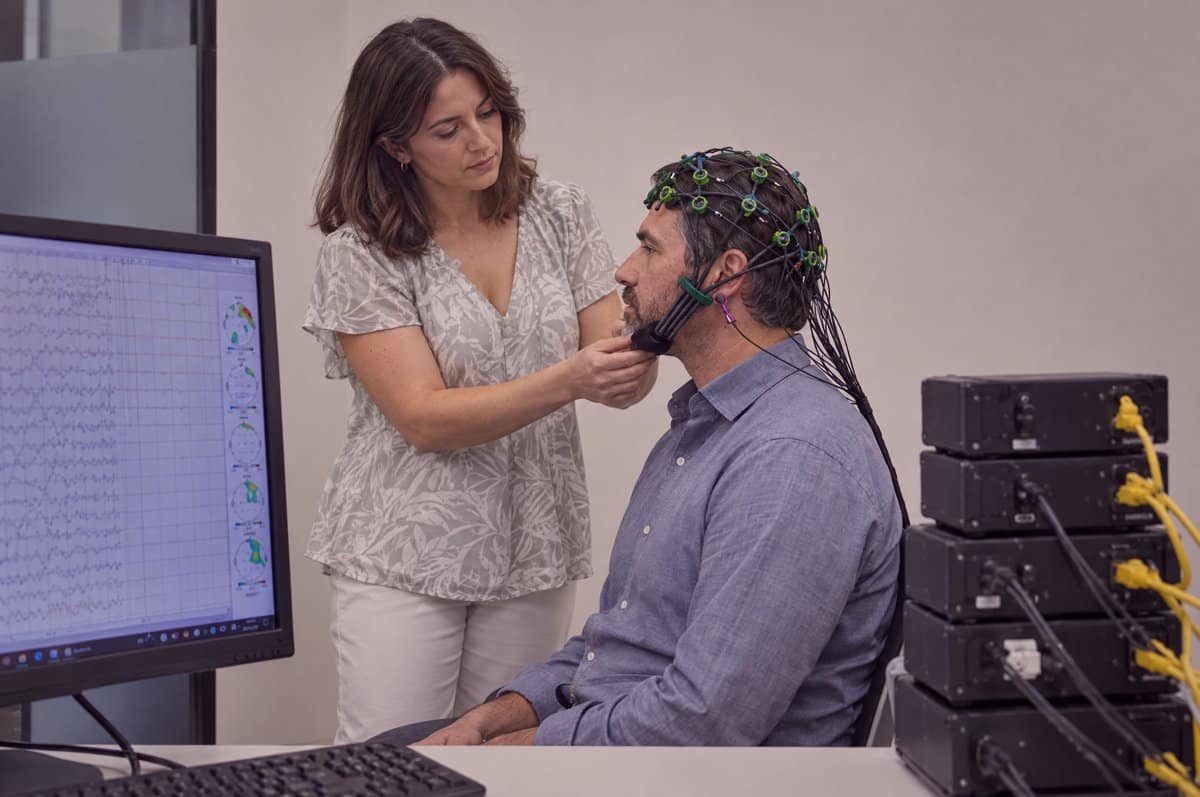
This is where our work adds something you will not find in mainstream articles. Every qEEG brain map starts with a few minutes of rest, eyes closed and then eyes open. It is, quite literally, Pascal’s room: sitting still, doing nothing. Many people discover this at that moment. The first minutes are often the hardest: the urge to move, to check the time, thoughts tumbling one after another.
What do we see? The best-known rhythm is alpha, roughly 8 to 12 Hz, which rises at the back of the head when you close your eyes and drops when you open them. Studies combining EEG and MRI show that default mode network activity varies with the power of alpha and beta rhythms (Mantini et al., 2007, PNAS).
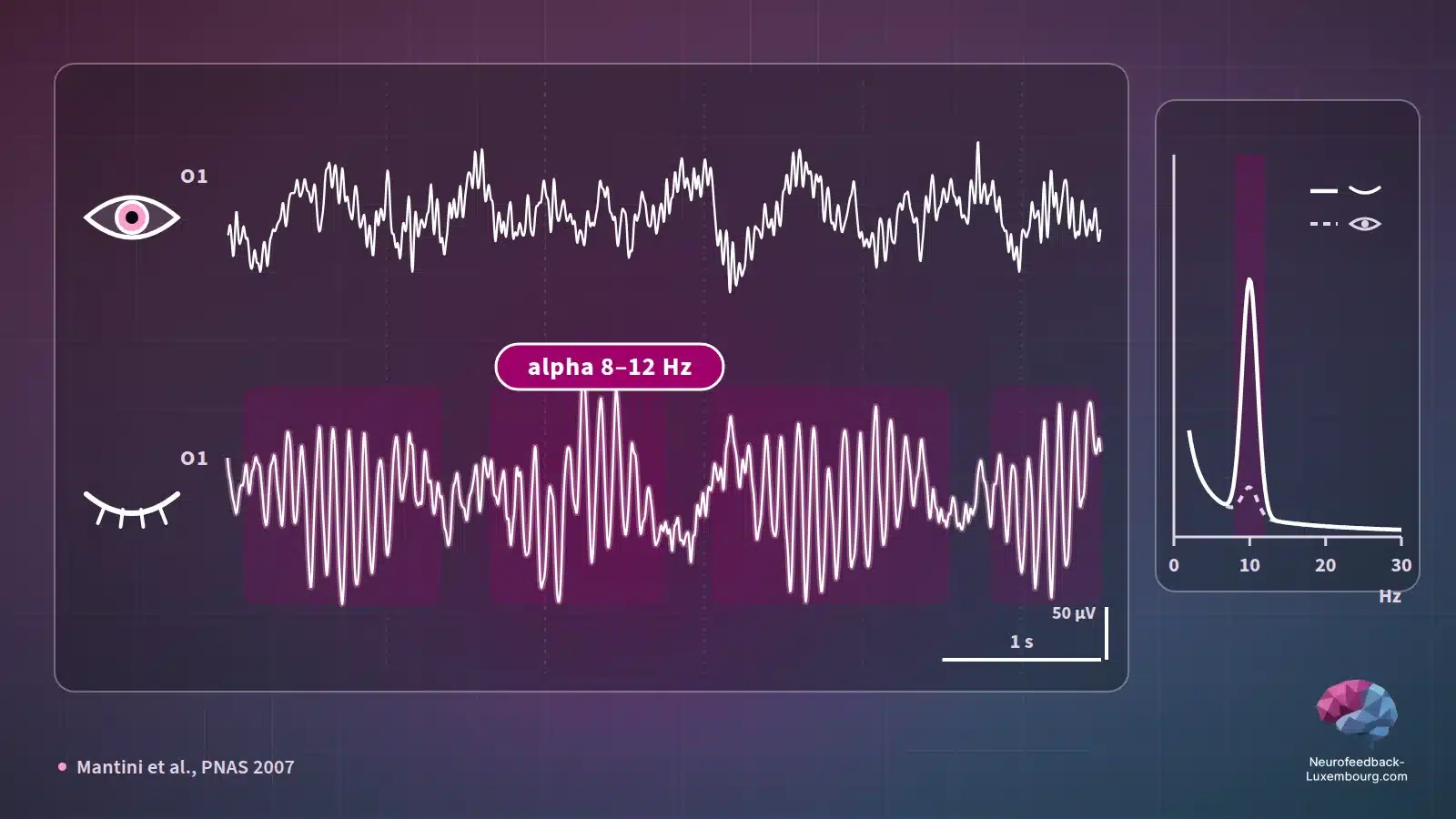
But let’s be precise, because this is where many people get it wrong:
- “Lots of alpha” does not mean “default mode network switched on”. The two are linked, but the links depend on conditions, such as eyes open or closed.
- A scalp EEG does not take a picture of the default mode network. It measures electrical activity at the surface of the head. Source-localisation methods such as LORETA give an estimate, not an image.
- A qEEG measures neither boredom, nor creativity, nor the “quality” of your default mode network. It compares your resting profile with a reference database and is used to build a training plan. Our technical requirements are set out in our article on qEEG standards.
On the neurofeedback side, a few lab studies show that a single session of alpha training changes the connectivity of these networks in the short term in healthy volunteers (Ros et al., 2013, “Mind over chatter”). It is an interesting result about mechanisms, nothing more: it allows no promise about boredom or creativity. As our founder François Altwies often says: you have to measure it.
The attention economy and Seneca’s otium
Luxembourg’s numbers speak for themselves. 94.5% of residents use the internet every day, against 89.5% across the European Union (Eurostat, 2025). According to the BEE SECURE Radar 2025, 17- to 30-year-olds spend an average of 5 h 14 a day on their smartphone, and 70% of them pick it up several times an hour (BEE SECURE Radar 2025, SNJ).
This is no accident. Tristan Harris, a former design ethicist at Google, calls it a “race to the bottom of the brain stem” (CBS 60 Minutes, 2017): apps built to hold our attention for as long as possible. The comparison with a slot machine, where the reward arrives unpredictably, is an analogy that researchers argue for, not a demonstrated experiment (Montag et al., 2019). The figures of “96” or “150” phone checks a day come from commercial surveys. A study that actually logged use found about 85 checks a day, and participants who estimated it at less than half that (Andrews et al., 2015).
The problem is old. In the video, Jay Shetty attributes to Seneca a line about boredom that we could not find in any of his works. The real Seneca is stronger. Two thousand years ago he was already describing “that weariness and dissatisfaction with oneself, that tossing to and fro of a mind which can nowhere find rest” (Of Peace of Mind, II, 10), and people who string journeys and spectacles together to flee themselves: “but what does he gain by so doing if he does not escape from himself?” (II, 14–15, translated by Aubrey Stewart, 1900).
His remedy is called otium: an active leisure devoted to reflection, not a void. “Leisure without study is death; it is a tomb for the living man“, he writes to Lucilius (Letter 82, translated by Richard M. Gummere). So the idea is not to do nothing, but to give your mind back time that belongs to it.
Four simple practices (and what to expect from them)
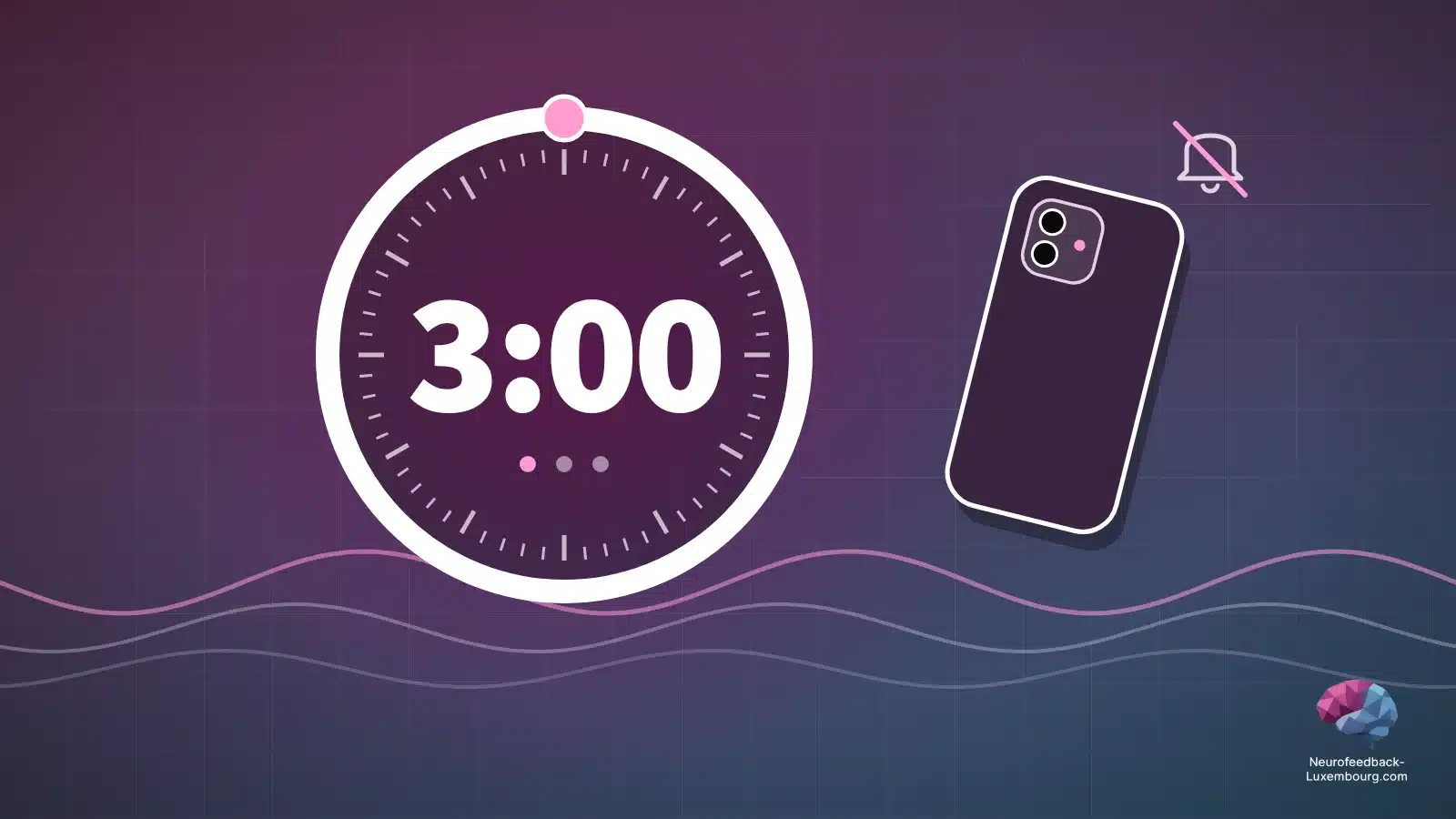
The four practices Jay Shetty suggests are good, low-risk habits. Here is how we would put them, with their level of evidence:
- Notice the reflex. The hand reaching for the phone in a queue is an automatic habit. Noticing it, without judging yourself, already opens up some space. Given that we underestimate our use by half, watching it is worth it.
- Hold for three minutes. When boredom arrives, stay three minutes without a screen or music. The first minute is uncomfortable: that is normal, and it is exactly what our clients go through at the start of a resting recording.
- One stimulation-free moment a day. Walk without earphones, have breakfast without your phone, do the dishes in silence. No study promises a precise result, but nothing argues against it either.
- Get bored before a hard problem. Ten minutes of undemanding activity before going back to a difficult question. This is the idea of “incubation”, the best supported of the four, even if its results are still debated.
And if you would like to see what your own brain looks like at rest, without hasty interpretation, that is exactly what a qEEG brain map is for. To talk it over, start with a free, no-obligation phone call.
Frequently asked questions
What happens in your brain when you’re bored?
When no outside task holds your attention, the default mode network takes over: memories, plans, thoughts about yourself and others. Boredom itself is an uncomfortable state signalling that your attention can find nothing to engage it.
Does boredom really make you more creative?
Not demonstrably. The original 2014 study was encouraging, but a 2023 replication did not find the effect, and a review of 27 studies concludes that no clear effect is established.
Does scrolling keep the brain from resting?
The default mode network stays active when you follow a story. What a constant stream of short content reduces is the moments of free, self-generated thought. That is the time worth protecting.
Can you see the default mode network on an EEG?
Not directly. A resting EEG shows rhythms such as alpha, which are linked to this network’s activity in indirect and variable ways. Source localisation (LORETA) gives an estimate, not an image.
Why does a qEEG recording start with rest?
Because the resting profile, eyes closed and then open, is the baseline for comparison with the reference data. It is also, often, the first time in a long while that you sit for a few minutes doing nothing.
Can boredom become a problem?
Passing boredom is normal. Chronic boredom, or negative thoughts that go round in loops as soon as things go quiet, are worth raising with a health professional.
Sources
- Jay Shetty Podcast, “You Need To Be Bored. Here’s Why.”, YouTube
- Pascal, Pensées, Laf. 136 / Br. 139, electronic edition of the Pensées
- Wilson T. D. et al. (2014). Just think: The challenges of the disengaged mind. Science, 345, 75-77. doi:10.1126/science.1250830
- Buttrick N. et al. (2019). Cross-cultural consistency and relativity in the enjoyment of thinking. JPSP. PDF
- Shulman G. L. et al. (1997). J Cogn Neurosci, 9(5), 648-663. doi:10.1162/jocn.1997.9.5.648
- Raichle M. E. et al. (2001). A default mode of brain function. PNAS, 98, 676-682. doi:10.1073/pnas.98.2.676
- Buckner R. L., Andrews-Hanna J. R., Schacter D. L. (2008). Ann NY Acad Sci, 1124, 1-38. doi:10.1196/annals.1440.011
- Menon V. (2023). 20 years of the default mode network. Neuron, 111, 2469-2487. doi:10.1016/j.neuron.2023.04.023
- Beaty R. E. et al. (2018). PNAS, 115, 1087-1092. doi:10.1073/pnas.1713532115
- Lerner Y. et al. (2011). J Neurosci, 31(8), 2906-2915. doi:10.1523/JNEUROSCI.3684-10.2011
- Simony E. et al. (2016). Nat Commun, 7, 12141. doi:10.1038/ncomms12141
- Yeshurun Y., Nguyen M., Hasson U. (2021). Nat Rev Neurosci, 22, 181-192. doi:10.1038/s41583-020-00420-w
- Mann S., Cadman R. (2014). Creativity Research Journal, 26(2), 165-173. doi:10.1080/10400419.2014.901073
- Nettinga J., Gutglick L., Danckert J. (2023). Journal of Boredom Studies, 1. doi:10.5281/zenodo.7993881
- Haager J. S., Kuhbandner C., Pekrun R. (2018). J Creat Behav, 52(4), 297-304. doi:10.1002/jocb.154
- Zeißig et al. (2024). Review of Education, 12(1). doi:10.1002/rev3.3470
- Baird B. et al. (2012). Psychol Sci, 23(10), 1117-1122. doi:10.1177/0956797612446024
- Murray S. et al. (2024). Psychol Aesthet Creat Arts, 18(3), 403-416. doi:10.1037/aca0000420
- Killingsworth M. A., Gilbert D. T. (2010). Science, 330, 932. doi:10.1126/science.1192439
- Smallwood J., Schooler J. W. (2015). Annu Rev Psychol, 66, 487-518. doi:10.1146/annurev-psych-010814-015331
- Westgate E. C., Wilson T. D. (2018). Psychol Rev, 125(5), 689-713. doi:10.1037/rev0000097
- Elhai J. D. et al. (2018). Soc Sci Comput Rev, 36(6), 707-720. doi:10.1177/0894439317741087
- Mantini D. et al. (2007). PNAS, 104, 13170-13175. doi:10.1073/pnas.0700668104
- Ros T. et al. (2013). Mind over chatter. NeuroImage, 65, 324-335. doi:10.1016/j.neuroimage.2012.09.046
- Montag C. et al. (2019). IJERPH, 16(14), 2612. doi:10.3390/ijerph16142612
- Andrews S. et al. (2015). PLOS ONE, 10, e0139004. doi:10.1371/journal.pone.0139004
- Harris T., CBS 60 Minutes, “Brain Hacking”, 9 April 2017. CBS News
- Eurostat, isoc_ci_ifp_fu, daily internet use, 2025. Eurostat database
- BEE SECURE Radar 2025, SNJ Luxembourg. PDF
- Seneca, Of Peace of Mind (De tranquillitate animi), II, 10 and 14-15, translated by Aubrey Stewart (1900). Wikisource · Moral Letters to Lucilius, 82, translated by Richard M. Gummere. Wikisource
Neurofeedback is brain training, not a medical treatment, and does not replace medical advice.